Author: Jonny Darling

  • From Love Triangle to the Tetrahedron of Love

    From Love Triangle to the Tetrahedron of Love

    Lacan announces in his seminar of 1962-63 that anxiety is “the only affect that does not deceive“. This short writing considers how the subject ($) appears in the aftermath of anxiety affect, according to the schema of division of the Other by the question of the subject.
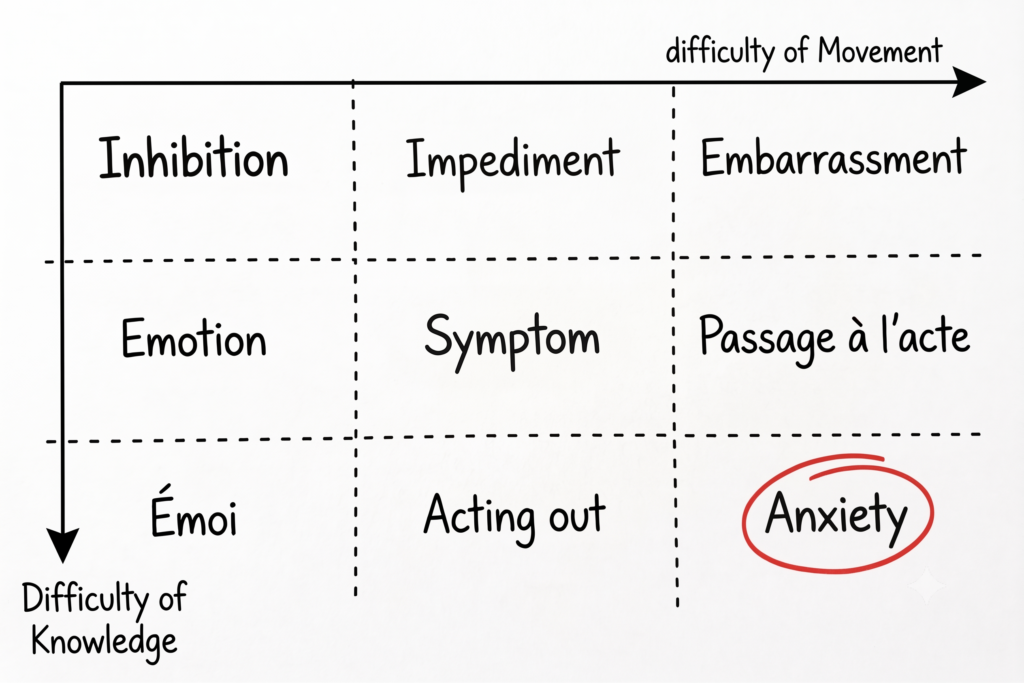
    Psychological matrix of movement vs. knowledge difficulty, highlighting anxiety.

    Lacan, following Freud’s reconceptualisation of anxiety, from asserting originally that repression causes anxiety, to reviewing anxiety as cause of repression, drops the barred subject down from the register of anxiety (a in relation to Ⱥ) to the register of desire (where nothing corresponds to $). The movement from schema 1 to schema 2 in Lacan’s Schema of Division of the Other by the Question of the Subject is under investigation, as is the Subversion of the Subject and the Dialectic of Desire in the shift of $ from the bottom-left to the bottom-right of the elementary cell in Lacan’s graphs of desire.
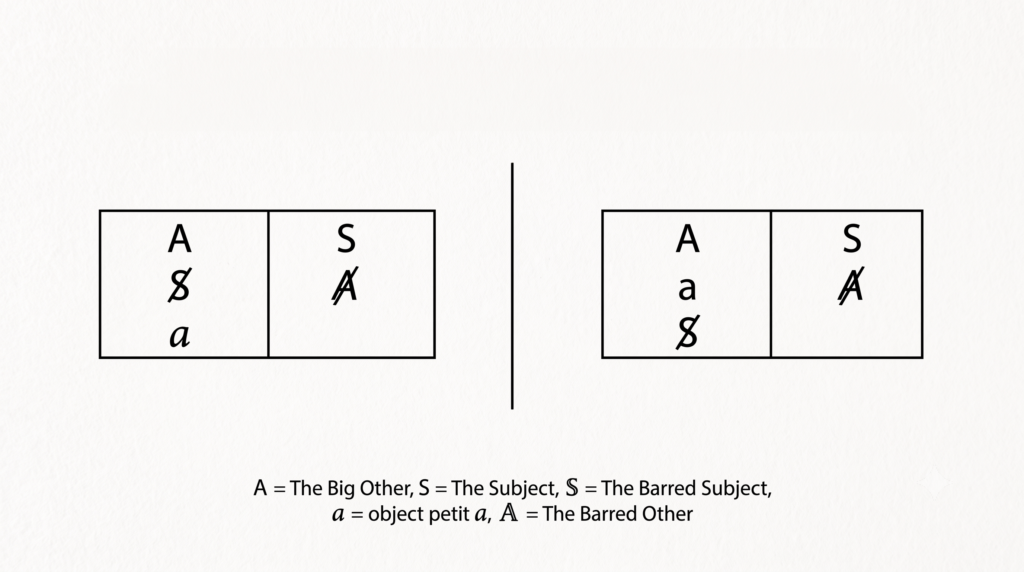
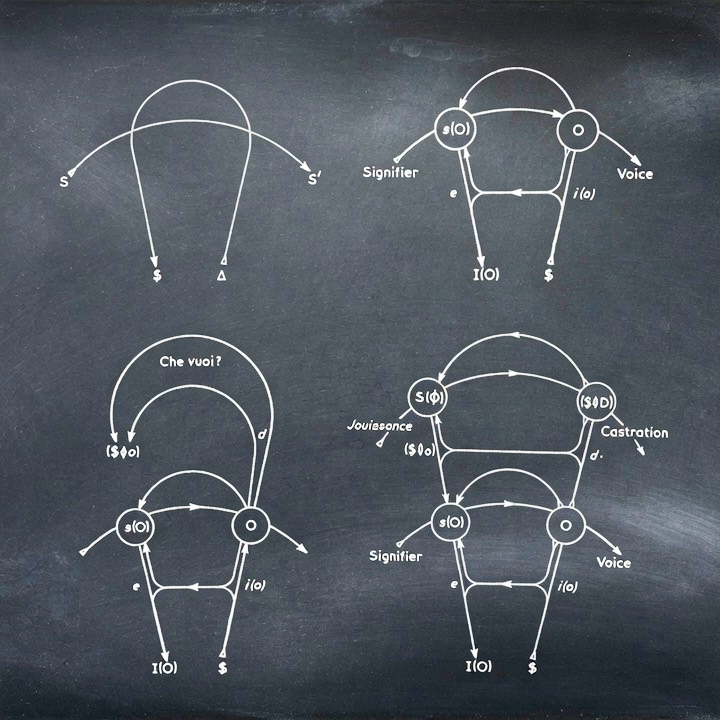
    Diagram illustrating Lacanian concepts including the Subject and Big Other.
    Four stages of Lacan's Graph of Desire on a chalkboard.

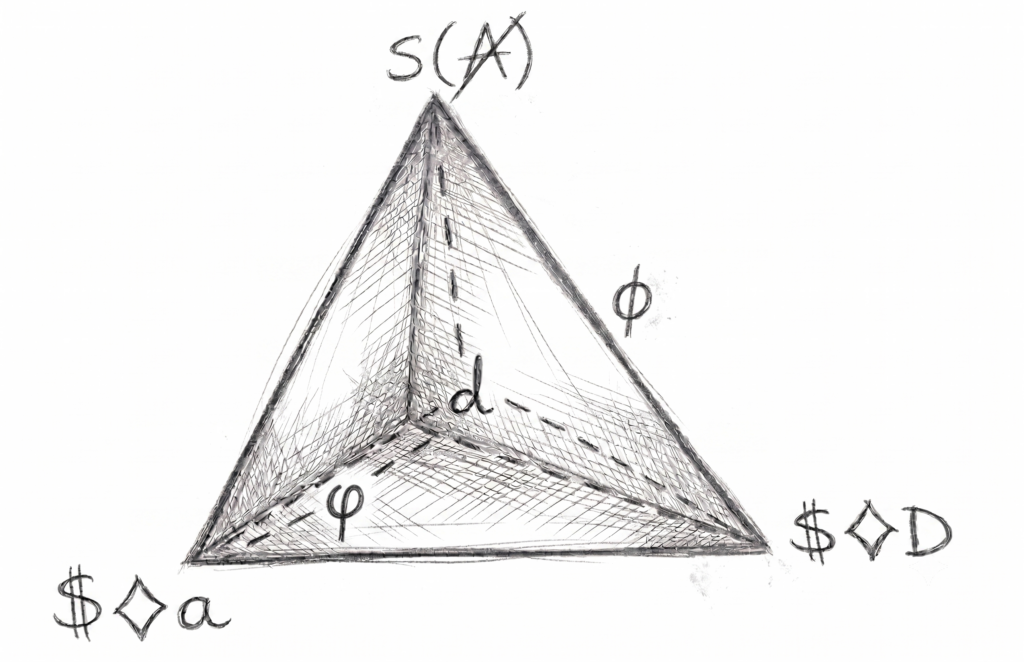
    Lacan insists in seminar X that anxiety “is not to be sought in the middle” (Lacan, p5). The bird, he specifies, has flown, with anxiety the remnant in the wake on the real. Anxiety is not at the centre of the 9-cell grid of ISA – Where anxiety might have been, there symptom may be(come) – nor a central linchpin to a structure of a speaking subject. The “upper line of jouissance” is oft referenced by Fierens, that is, at the level of Che Vuoi?. This is the division of the Other by the question of the subject, Ⱥ, or S (Ø) in the Graph of Desire. The first conception of the quadrilateral structure is the familiar Lacanian schematic mapping employed in the four discourses, schema L and so on. The second conception revolves around the rotation of these tetrapods, the free-floating or evenly-suspended four-faced tetrahedron. With the predisposition to secure a solid triangle which is fully-visible from all angles (knowledge), the challenge for psychoanalytic practice is to allow for the fourth element in the matheme that remains in the background, notwithstanding the five objects of psychoanalysis (movement).

    The Lacanian formula that only love allows jouissance condescend to desire is reflected upon repeatedly in A Reading of Anxiety by Christian Fierens. Might love, defined by Lacan as giving what one does not have to someone who does not want it, be read as a writing over anxiety (a | Ⱥ) at the median register of the schema of division of the Other by the question of the subject?

    The clinical operation, the function of psychoanalysis for Lacan, is to move the subject further along the symbolic order. Respect is the order of the day. Chapter 5 of Fierens’ The Jouissance Principle, titled ‘Respect (Achtung)’, is instructive. Here, Fierens is working fastidiously on Kant’s Critique of Practical Reason:

    . . . self-satisfaction which is nothing but self-conceit (Eigendünkel). Practical reason confronts the self-love (Selbstliebe) which corresponds to narcissism, not in order to suppress it, but in order to limit it, more precisely in order to bring it into agreement with the moral law. It therefore transforms narcissism into a “rational self-love”, whereas it strikes down self-conceit. True self-esteem ( Selbstachtung), true narcissism rests solely on morality (Sittlichkeit). The negative effect of the moral law on feelings (pain) is thus directly counterbalanced by a positive effect, true self-esteem, true self-respect (Selbstachtung), or to be brief, respect (Achtung).

    Read in conjunction with A Reading of Anxiety, Fierens proposes his second conception of the signifier as the movement from S¹ to S², or the ideal ego to the ego ideal. He writes of the emptying of the imaginary in S¹, and the hollowing out of an inflated ideal ego. This would not be so revelatory were it not a subtle re-reading of how to conceive of the signifier. In the first conception, practical reason, reality, the barred big Other, confronts the split subject head-on. This is the tyranny of the Shoulds, a categorical imperative. In the second conception, the moral law is equivocal in the face of respect. Fierens writes:

    Morality must necessarily be inscribed within the register of the drives by means of respect. With regard to the second question: is it not suitable to inscribe morality within the register of the drives by a sensible means other than respect – love, for example?
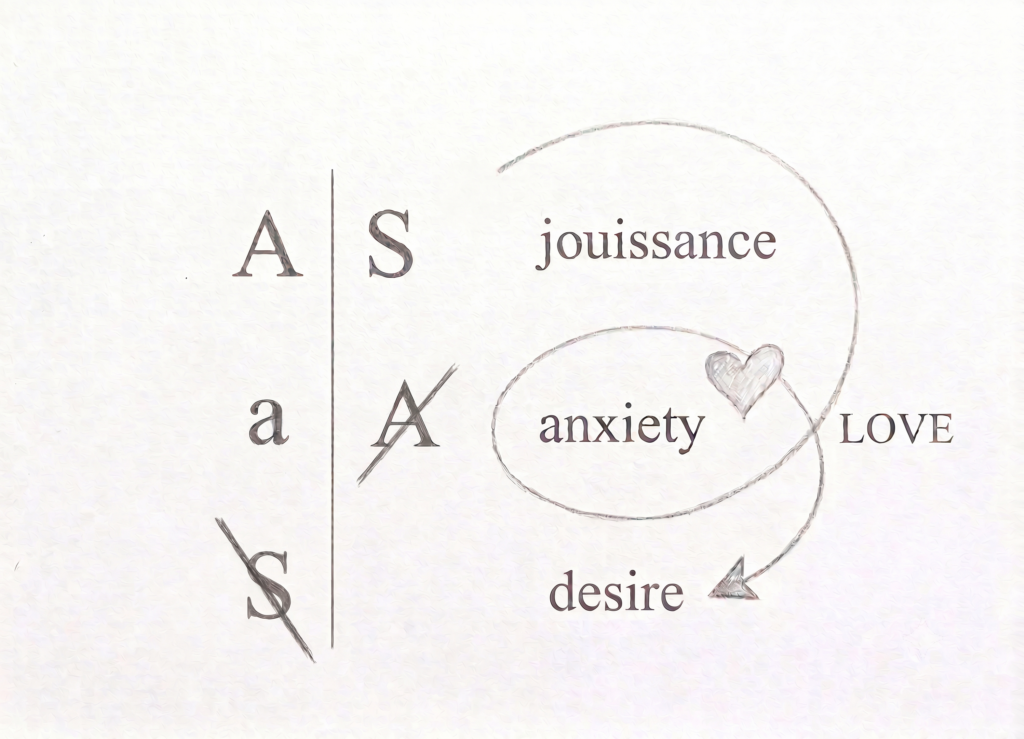
    Conceptual diagram featuring psychological terms and symbolic letters.

    To speak of an object cause of desire beyond self-interest, of universal slash particular interests, in their plus/minus formulations of all, not-all, there exists, non-existence, and in the oral, anal, phallic, scopic, and vocal objects, is to move beyond quantification whatsoever to logical qualification. This may be represented in the question On a discourse that might not be a semblence, not the discourse of the psychoanalyst, nor the Lacanian aphorism:
    That one might be saying remains forgotten behind what is said in what is heard“, where, for Fierens, Lacan’s four (intentional?) mistakes are, working retroactively;
    (1) Heard -> (2) Said -> (3) Forgotten -> (4) Saying >>>

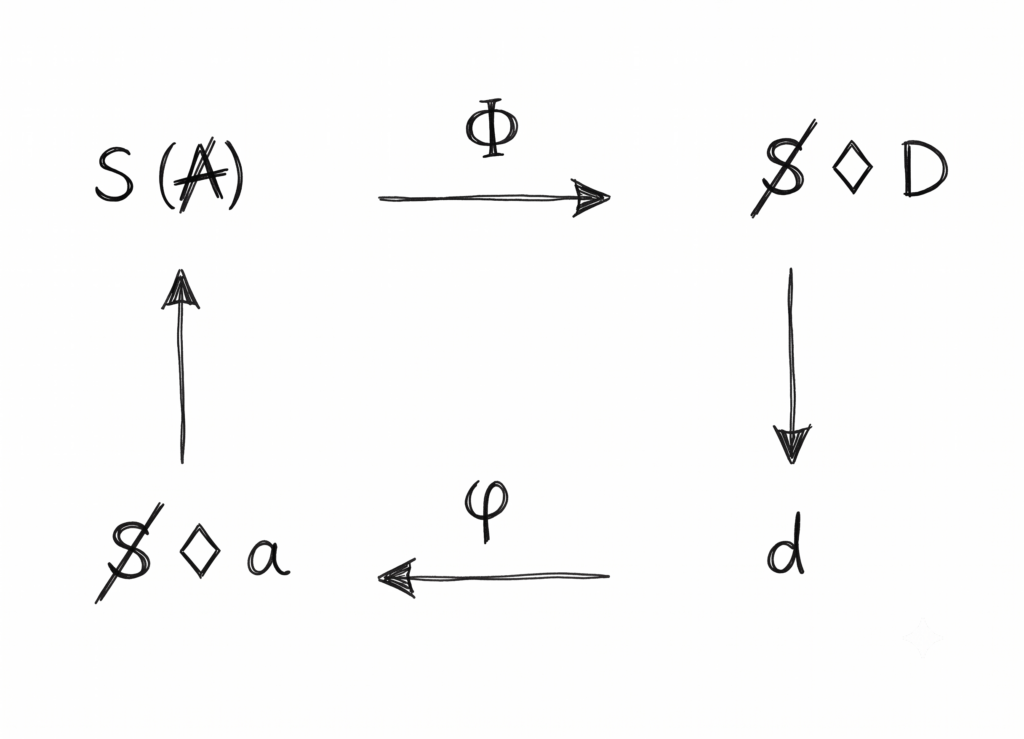
    Hand-drawn mathematical diagram with symbols and arrows.
    Hand-drawn sketch of a tetrahedron with mathematical symbols and cross-hatching.

    In truth, the saying, c’est ça et ce n’est pas ça, is it and it’s not it. Saying speaks to the fifth object in its fainting/feinting, a voice on the wind, an empty object without a concept. To conceive of the psychoanalytic discourse is to fall in love, through the anxiety-laden defiles of the signifier, with deceiving as a psychoanalytic act. This is a far cry from statement. The subject is at stake in the changing over and above any object, empty or otherwise. Otherwise, the more it changes, the more the same thing; Plus ça change, plus c’est la même chose!

    $ is nowhere to be found, and yet in absentia from the aphorism, a possibility to invent. In the introduction to A Reading of Anxiety, Fierens puts the reader to work as follows:

    One must redo the work oneself so that such a reading might be fruitful. The integral transmission of the Lacanian contribution implies the ‘matheme’, but the matheme should never be understood as the borrowing of a mathematical formula to be pasted onto a psychoanalytic problem. The matheme is the process whereby one does it by oneself, by tracing, even questioning the path which invents the answers (this is what happens in mathematical practice) and these answers re‑launch the questions. This is the sense of my reading of this seminar: Anxiety invites the reader to read and reread the text for himself, to trace his own path, to rediscover how things intersect and don’t intersect, and by these means, to move forward in the richness of an inventive reading.

    The subversion of the subject is a turning upside down and inside out of the subject, a subject that is toppled in order that work may be done – condescending to the couch perhaps…
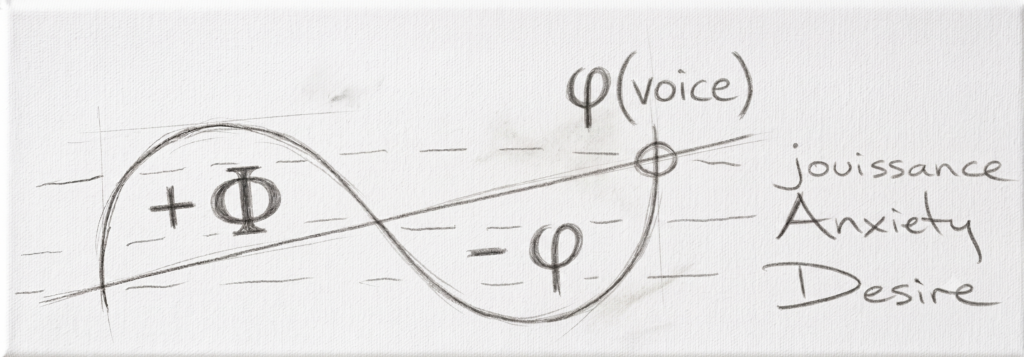
    Hand-drawn Lacanian diagram with Greek symbols and psychoanalytic terms.

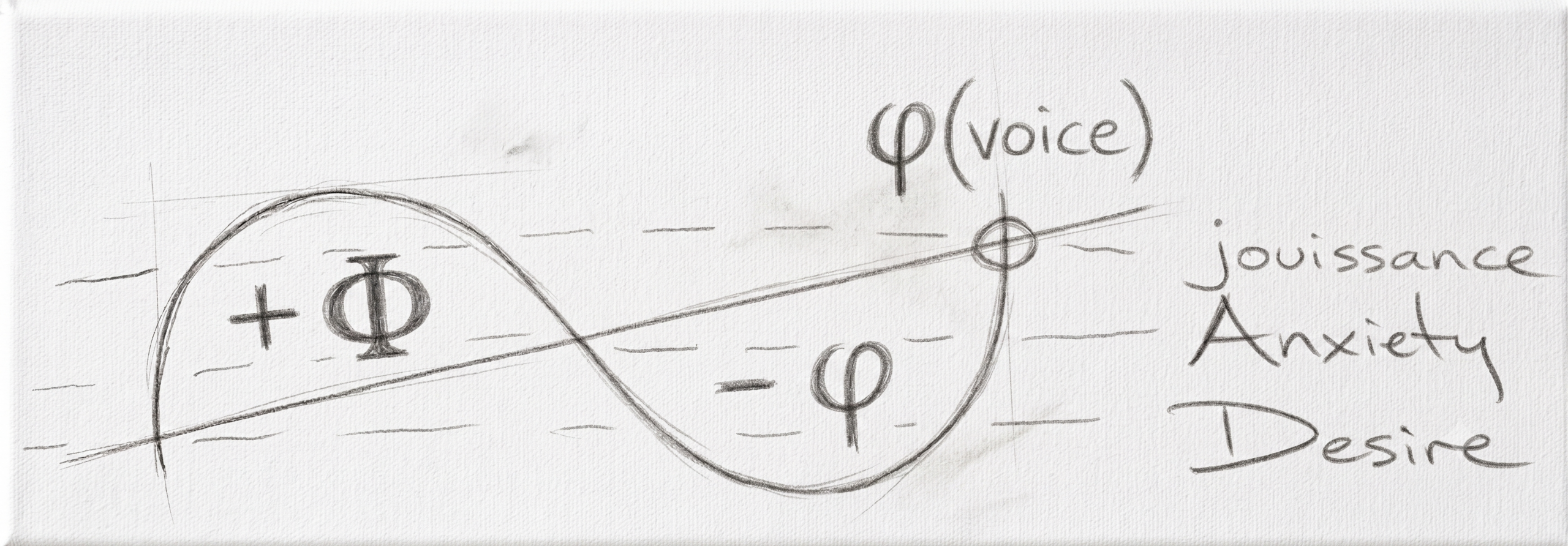
    The loci of the argument is that the voice is decoupled from the vocal object. The voice on the wind does not emanate from a source so to speak. The wind is the voice inasmuch as language swirls about the speaking subject. These are the stakes at play, in playing instrument, a wind instrument.

    The first movement is proficiency at play; The long labour of apprenticeship in the musical tradition, be it training to play the wind instrument or the technique of a classically-trained singer. The second movement is instrumental. Imbued in music, the subject moves from loving to sing and play (S¹) to a love of music, a respect for the work (S²). This is repetition at the upper level of the graph of desire. The subject is now in the process as an instrument, harnessing the renewable resource of wind itself. This does not go without saying (and this prelude says too little of the process; misunderstanding rectification as of breaking-in of mythical subject, rather than breaking-ground in order to conceive of a subject-in-the-making). There are no shortcuts as Fierens explicates; It takes will-power, volante de jouissance. Jouissance drives the subject on, anxiety is not without an object; These are the essentials to love and work with gusto as a desiring subject. Voilà!
    Mathematical diagram featuring a wave and Greek phi symbols.
  • Excusez-moi! Pardon my French…

    Excusez-moi! Pardon my French…

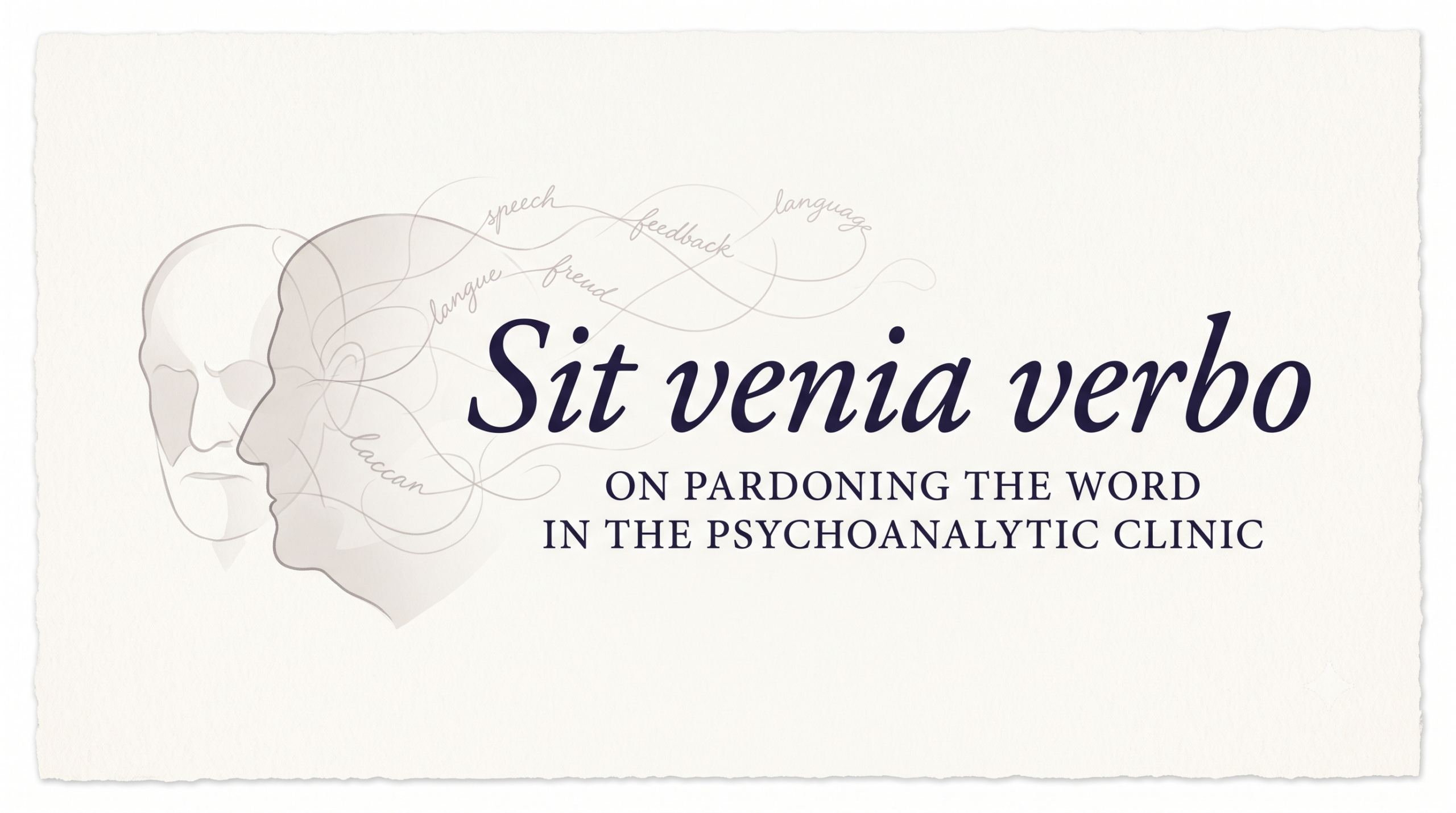
    “Sit venia verbo” is a Latin phrase employed by Freud in the ‘Wolf Man’ case, and highlighted by Lacan in his Rome discourse presentation. If you’ll permit me, I’ll read the passage from The Function and Field of Speech and Language in Psychoanalysis:

    Freud plainly stressed this when, unable to avoid a conjunction of opposing terms in the expression “unconscious thought”, he gave it the necessary support with the invocation: sit venia verbo. Thus we obey him by casting the blame, in effect, onto the Word, but onto the Word realised in discourse that darts from mouth to mouth, conferring on the act of the subject who receives its message the meaning that makes this act an act of his history and gives it its truth.

    In the chapter headed ‘Anal Erotism and the Castration Complex’ in From the History of an Infantile Neurosis, Freud discusses what Lacan terms analytic symbolism as opposed to analogical thinking. Freud is reviewing the patient’s presentation, specifically what passes for an exchange of gifts in the history of the subject. He writes,

    The handing over of faeces for the sake of someone else becomes a prototype of castration; it is the first occasion upon which an individual parts with a piece of his own body in order to gain the favour of some other person whom he loves. So that a person’s love of his own penis, which is in other respects narcissistic, is not without an element of anal erotism. ‘Faeces’, ‘baby’ and ‘penis’ thus form a unity, an unconscious concept (sit venia verbo) – the concept, namely, of ‘a little one’ that can become separated from one’s body.

    An invocation is forsaken to call upon a higher authority for the support necessary to produce expression, in this case, the incompatible combination of the words “unconscious thought”. Lacan begins his exposition by invoking Freud. Lacan’s work is predicated on the work of Freud before him. Lacan, arguably, is the antithesis of Freud, in the Hegelian tradition of dialectical reasoning. Freud was ante-Lacan, insofar as Freud was before Lacan’s time, and for Lacan, Freud was before his time as the founder of psychoanalysis. Our ISLP Cartel this year launched on foot of Paul Verhaeghe’s work, specifically his commentary on Lacan’s ‘Discours de Rome’. He stakes out the three aims of his talk, that is, the historical context in which Lacan delivered his paper in 1953, the substance of the presentation itself, and the revision thereof ten years later in preparation for the publication of his Écrits. Following Lacan’s example, Verhaeghe is accentuating the importance of what has gone before and what is yet to come in situating the speaking subject currently.

    Sit venia verbo translates literally as “forgive the word”. What follows is an examination of the invocation and what it implies for psychoanalytic practice. In the beginning was the word, from the Gospel according to St. John, as referenced by Lacan. He considers Freud’s remarks on Goethe’s reversal of word and deed, the act bringing forth the word, but refuses it by return. The speech act is predicated on language as a sounding-board, a feed-back loop that expands the range of language. Speech performs its function of nourishing the field of language. This is the regenerative circular economy of speaking. It continually replenishes language. Language is both the necessary support for, and remains of, expression. The first point to emphasise is that the word is fore-given in advance and speaking advances language.

    This leads on to language as an inheritance. Language is inherited from our forefathers. Latin is no longer a language in everyday parlance, yet informs modern day languages still. Living languages are the inheritance of dead languages before them. Native speakers hold no right or title to the language per se. The word is not a deed owned by the inheritor. The beneficiary does not have sole ownership of the words bequeathed him. Ergo, he does not speak in his own words. Instead, he has a responsibility to pass on the gift of language with compound interest.

    Why then the appeal for forgiveness on behalf of the forsaken word? Why should the word take the blame for a poor performance by a bad actor? It is speech that performs, as Derek Hook writes in On the role of speech in psychoanalysis: Revisiting Lacan’s ‘Function and Field’, and is performed by the agent, or patient, as actor. Bad language is at times employed to get the point across with theatrical effect, but there are no right or wrong words. The blame games start when the speaker begins to think that he is in the right. A certain penitence is at stake where certainty is concerned. Certainly, that is what Lacan is staking out, and not without due regard for the words of common prayer, wherein;

    Almighty God, our heavenly Father, we have sinned against you and against our neighbour, in thought and word and deed, through negligence, through weakness, through our own deliberate fault.

    The three-fold sin of thought, of word and of deed are on the register as a conviction in knowledge. The convict is the speaking subject and he has only himself to blame. His own deliberate fault is on the side of knowing. Cormac Gallagher’s reading of The Psychoanalytic Act in 1967-1968 opens with the declaration; “To set out my stall right away, I would say that my understanding is that what Lacan is trying to do is to tip the balance away from psychoanalysis as science towards psychoanalysis as logic”. What he articulates is the necessity of a “leap of faith” away from the securities of the subject supposed to know to the shifting ground of quantification theory. He says, “There is a vital step that they have still to be persuaded to take if they are to assume their role as ‘instruments of revelation’ rather than subjects of knowledge”. Somewhat surprisingly, Gallagher’s reading of Lacan is that the subject supposed to know remains a subject of knowledge, for all his education to the contrary. The problem for Lacan, and Freud before him, is the analyst’s formation. The trajectory of training promises entitlement and authority, which only facilitates the pretence of performing psychoanalysis. Both looked to distance themselves from the direction that psychoanalysis was taking in their time, a direction which they both took to be negligent, weak and faulty, as it placed the emphasis on the analyst as author with the title deeds to knowledge, when the opposite is true. The leap of faith is an invocation to return to the shifting ground of linguistic fieldwork. The psychoanalytic act is to marvel at the logic of language, and believe in the power of words as a talking cure. This action goes beyond a performance of mimicry and mastery, of verbosity and erudition, to an act of speaking well, with respect to words. It is an action that speaks louder than words in wonder of the Word.

    Freud writes in The Question of Lay Analysis that the psychoanalytic clinic is “sui generis”, a singular discipline wherein it is “impossible to treat a patient without learning something new”. In his ‘conversation with an impartial person’, he argues against psychoanalysis as exclusively the vocation of the medical establishment. Instead, he would see the analyst as a “secular pastoral worker”, au fait with such branches of knowledge, as he calls them, as the “history of civilisation, mythology, the psychology of religion and the science of literature”. To this, Lacan adds weight to “rhetoric, dialectic, grammar, and poetics”. Psychoanalysis is here distinguished as a clinic of language, in contradistinction to speech and language therapy. The pastoral worker returns the speaking subject time and again to the field of language to turn words over anew. As “instruments of revelation”, the clinician forgives the word, so to speak, for the sake of the subject. The lasting words can be Lacan’s from seminar eleven:

    Is agriculture a science? Some people will say yes, some people no. I offer this example only to suggest to you that you should make some distinction between agriculture defined by an object and agriculture defined, if you’ll forgive me, by a field – between agriculture and agronomy.

  • Future Anterior of Psychoanalysis

    Future Anterior of Psychoanalysis

    Early in the course of his 1957-1958 seminar, ‘The Formations of the Unconscious’, Jacques Lacan determines that “a discourse is something which leads somewhere, has a fabric, a texture”(Lacan, 1958, p6). Discourse is what we have to work with, the stuff of psychoanalytic work, and “once you’ve got caught in the wheel of this word-mill, your discourse always says more than you are saying”(Ibid. p8). The practitioner, the one who is supposed to know, holds that “the more this discourse is coherent and consistent, the more it seems to lend itself to all kinds of absence with respect to what can be reasonably defined as a question posed by the subject regarding his existence as subject”(Ibid. p75).

    The psychoanalytic position holds true to the unconscious, and Lacan approaches it, though it is not an object, by going out of his way, so to speak, via speech. After all, “the truth requires us to go out of our way”(Lacan, 1957, p521), so says Lacan. In The Function and Field of Speech and Language in Psychoanalysis, Lacan says that “The unconscious is the chapter of my history that is marked by a blank or occupied by a lie: it is the censored chapter. But the truth can be refound”(Lacan, 1953, p259). He follows Freud’s guidance as to where the unconscious lies hidden; “The list of disciplines Freud considered important sister sciences for an ideal Department of Psychoanalysis is well known. Alongside psychiatry and sexology we find ‘the history of civilization, mythology, the psychology of religions, literary history, and literary criticism”. He goes on; “For my part, I would be inclined to add; rhetoric, dialectic, grammer, and poetic – the supreme pinnacle of the aesthetics of language which would include the neglected technique of witticisms”(Ibid. p288).

    Freudianism, for Lacan, “constitutes an intangible but radical revolution”(Lacan, 1957, p527) and we should be shocked, flabbergasted with surprise by what he says, by what Freud said. The word “surprise” stems from the old French word “sorprendre”, translating as over-take. The Latin “prendere”, from prehendere, is to grasp, prae indicating before and hendere to seize or to take. The etymology is instructive insofar as we brush past something in the nature of surprise that touches us profoundly with the faintest glance. Surprise is not anticipated before it takes us, psychically seizes us, stuns us, for a moment we are petrified. We are, in an instant and in parallel, operating on various planes, over and under, before and after, seizing some form of prehension but also losing our bearings. Where are we at this moment? In the unconscious?

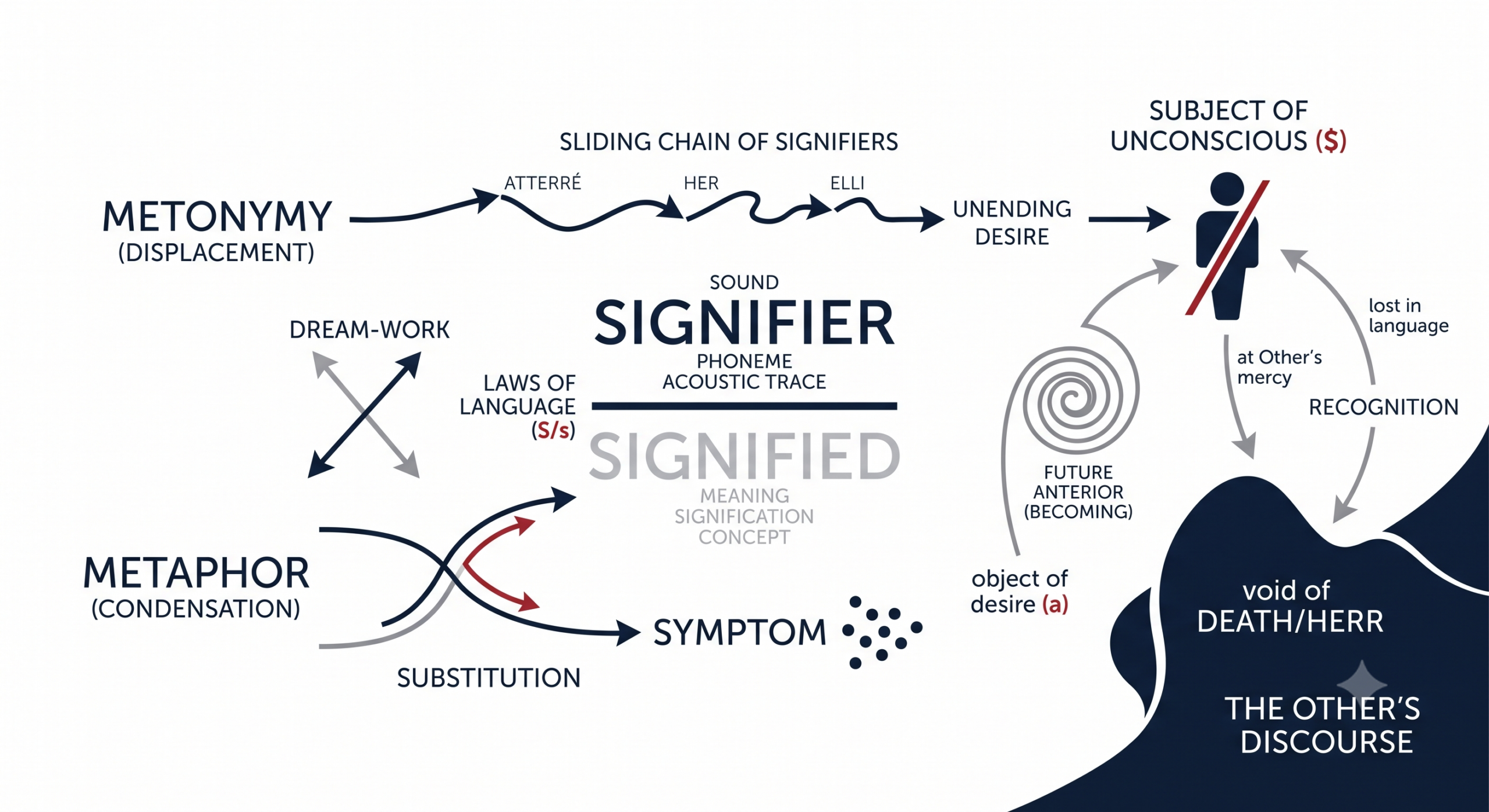
    Freud articulated in his elaborate case notes and applied examples what Lacan went on to formulate in his practice; presentations of ambivalence and equivocation, ambiguity and multiplicity in the mechanisms of the unconscious. For Freud, “The interpretation of dreams is the royal road to a knowledge of the unconscious activities of the mind” (Freud, 1900, p608), condensation and displacement the fundamental mechanisms of the dream-work. According to Lacan in The Instance of the Letter in the Unconscious or Reasons Since Freud, “what is at stake on every page in The Interpretation of Dreams is what I call the letter of discourse”(Lacan, 1957, p509). So it is that Lacan selects the field of language and the function of speech as his entry point to the unconscious; “Verdichtung, ‘condensation’, is the superimposed structure of signifiers in which metaphor finds its field [] Verschiebung or ‘displacement’ – this transfer of signification that metonymy displays”(Ibid. p511). Before we address Lacan’s hypothesis relating, but not equating, metaphor to condensation and displacement to metonymy, we must understand something of the signifier and the signified in the laws of language derived from structural linguistics. Lacan announced that “the major theme of this science is thus based, in effect, on the primordial position of the signifier and the signified as distinct orders initially separated by a barrier resisting signification”(Ibid. p497). He asserted that “the decisive discovery of linguistics, are phonemes [] the synchronic system of differential couplings”(Ibid. p501). We are in the realm of acoustic traces, mnemonic images, primordial echoes, sounds that mean something quite unique to the subject based on his singular formation, his signifiers. We have heard as much before from Freud in speaking of the dream-work in chapter six of Jokes and their Relation to the Unconscious, whereby dream-thoughts, entirely rational and constructed with all the psychical energy we can muster, are reproduced exclusively or predominantly through visual or acoustic memory traces, which give rise to considerations of representability in the content of the dream-work. As such, what is signified, represented in language, in relation to the signifier, the audible content of speech, is far from universal; this may be that, or it may not, may be both, or “It’s that and it’s not that” as Christian Fierens writes in The Psychoanalytic Discourse (Fierens, 2012, p8).

    “Freud shows us in every possible way that the image’s value as a signifier has nothing to do with its signification”(Lacan, 1957, p510), Lacan credits. The primacy of the signifier over the signified is pivotal. Lacan’s thinking was formed by, though at variance to, scholars of linguistics, especially Charles Sanders Peirce, Ferdinand De Saussure and Roman Jakobson. His invention was to place the signifier, the phoneme of speech, above the signified but permit the “sliding” dual-axis reciprocal relationship between sound and meaning in space and time; “This two-sided mystery can be seen to intersect the fact that truth is evoked in that dimension of ruse whereby all ‘realism’ in creation derives its virtue from metonomy, as well as this other fact that access to meaning is granted only to the double elbow of metaphor”(Ibid. p518). The technique of psychoanalysis lies, and it is a psychoanalytic act of being duped, in the evocation of truth momentarily transmitted in the act of saying, all the while barred by the wall of language into which we are born, notall free to mock our chains. Lacan corrects those who might abandon speech to speak of countertransference, resistance, or object relations for “it was the abyss, open to the thought that a thought might make itself heard in the abyss, that gave rise to resistance to psychoanalysis from the outset – not the emphasis on man’s sexuality, as is commonly said”(Ibid. p523).

    Let us follow Lacan’s applied example of the French word for aghast or terrified. He tells us that “Atterré does not originally and in many of its uses, have the meaning of to be struck with terror, but rather of landing”(Lacan, 1958, p19) and further, “There is something that we cannot say as long as the words do not exist, and these words come from a metaphor, namely what happens when a tree is abuttu, or when a wrestler is grounded, atterré, second metaphor. [] The word atterré does not bring about meaning insofar as it has a signification, but qua signifier, namely that having the phoneme ter, it has the same phoneme which is in terror. It is by the signifying path, it by the path of equivocation, by the path of homonymy, namely by the most nonsensical thing possible, that it comes to engender this nuance of meaning”(Ibid. p20). We are introduced to something of the inherent complexity of meanings that a single word made up of three syllables, phonemes, can arouse, a “sliding of meaning in the metonymical chain”(Ibid. p54). Atterré is commonly understood to signify fear, to be all at sea and out of our depth but underlying the word is safe-harbour, an anchoring point from which to reach dry land. According to Lacan, “one of the clearest demonstrations that Freud ever gave of the mechanisms of the analysis of a phenomenon of formation or deformation, linked to the unconscious”(Ibid. p24) was of the case between Signorelli, Boltraffio and Botticelli in The Psychopathology of Everyday Life, exhibiting the phenomena of the signifier par excellence. Through pain-staking analysis and the most tenuous of associative threads, the forgotten Signorelli emerges from the “elli” of Botticelli, “bo” from Boltraffio produced from something incomplete in Bosnia Herzogovina, Freud’s multiple psychical associations, to “trafoi” in relations to a patient’s suicide, but namely to “Her”, or Signor. For Lacan, “It means that all that we discover are metonymical ruins connected with a pure and simple combination of signifiers”(Ibid.) and that ultimately, but not univocally, the train of thought is thus; “Death is the absolute Herr. But when one speaks of Herr one does not speak of death because one cannot speak of death, because death is precisely both the limit and probably also the origin of all speech”(Ibid. p40).

    The limitations of language are confounding and yet I speak in order to be heard, to be heard that I might be understood. Do you know what I mean when I say what I am saying? Do I? Lacan suggests that “what is here transmitted, is relaunched in a double operation [] in so far as the Other has received what is presented as a peu de sens, it transforms it into what we ourselves have called, in an ambivalent, equivocal, fashion the pas-de-sens”(Ibid. p72). What I am saying, though frantically followed up by secondary revision to tidy up my nonsense, is nonetheless registered by another, which returns a flicker of meaning to my speech. I wish to speak, I am a desiring subject of the unconscious, “splitting from myself, as if from a semblable”(Lacan, 1957, p524). A dialectical division is evoked; “If I have said that the unconscious is the Other’s discourse (with a capital O), it is in order to indicate the beyond in which the recognition of desire is tied to the desire for recognition”(Ibid.). What could be more terrifying, anxiety-provoking, than to place oneself at the Other’s mercy? But that is the price we pay for human existence, the pact we wager on living; either remain infans, speechless, a-dict, psychotic, or engage the Other in the laws of language, acquiesce to their demand, and desire beyond satiation that we do not know we desire, our object of desire, small other, peu de sens, grain of truth. As long as we are speaking, we desire the Other’s recognition. In return, we operate at the level of the signifier, the sounds of speech and yield to the Other’s demand, which “is originally de-mandare, it is to entrust oneself, it is on a common level of register and of language as a giving over of one’s whole self, of all one’s needs to another”(Lacan, 1958, p66).

    Lacan determines that “I identify myself in language, but only by losing myself in it as an object. What is realized in my history is neither the past definite as what was, since it is no more, nor even the perfect as what has been in what I am, but the future anterior as what I will have been, given what I am in the process of becoming”(Lacan, 1953, p299). Becoming, as in saying, is not a state, it is a movement, a deficient movement towards death. I might rush headlong toward my terminal safe-harbour, to objectify what I am saying as said, to terminate the tortuous process of speaking while I know not what I say, fill the absence from myself and attempt meaning in the signified of death’s void, but as long as I am speaking, I am not dead, not signified….I am beyond representation. The meaning of life might indeed be death, and if psychoanalysis is dead, long live psychoanalysis, for it keeps me saying more.

  • Psychoanalysis Upside Down; Book XVII

    Psychoanalysis Upside Down; Book XVII

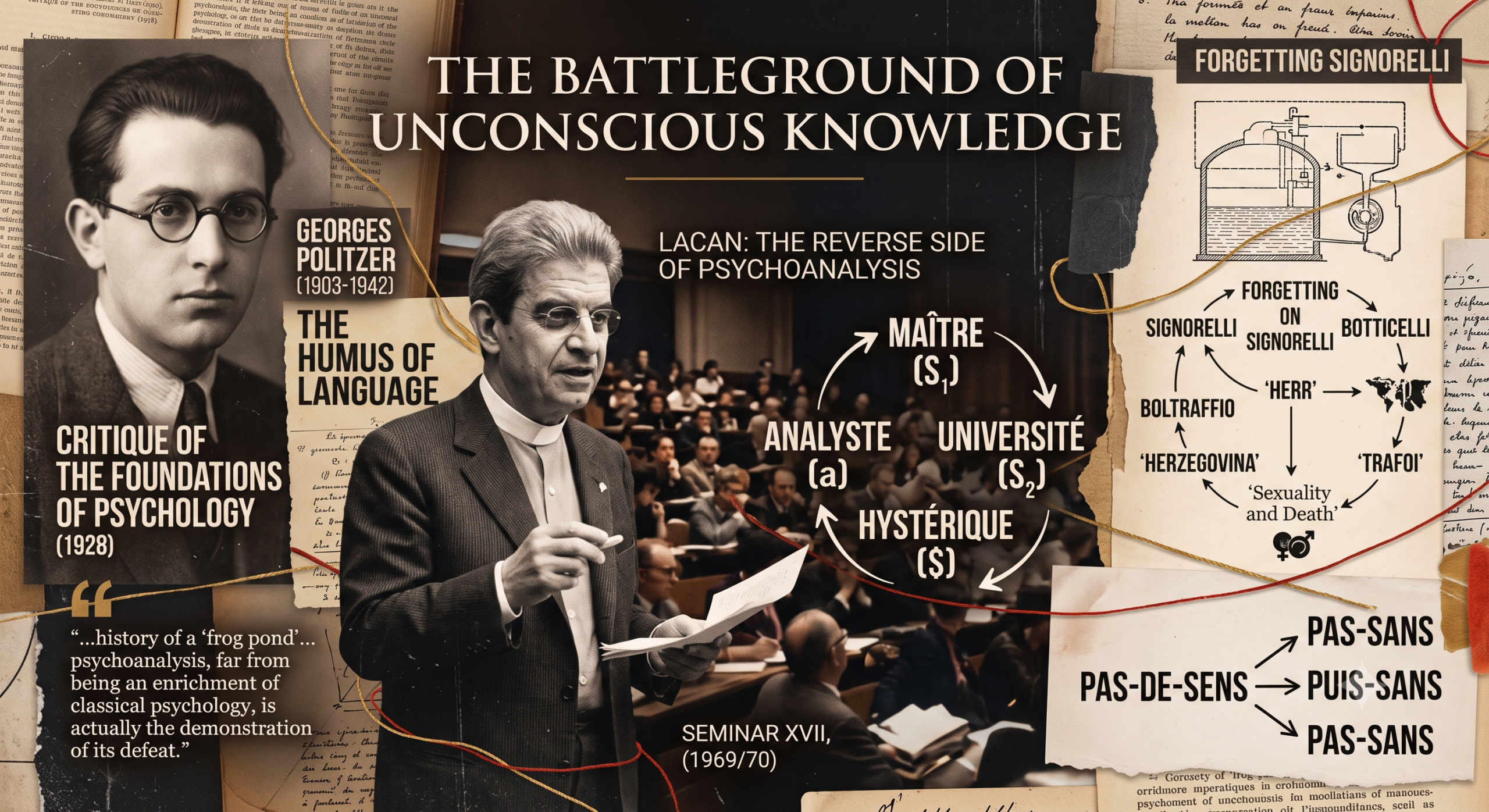
    Georges Politzer, born 3rd May 1903, executed by firing squad 23rd May 1942, published his Critique of the Foundations of Psychology in 1928. It was subsequently re-edited in 1969, as Lacan remarks in his 1969/70 Seminar on The Reverse Side of Psychoanalysis, “without, to my knowledge, anything being able to show that the author would himself have apporved of this new edition, whereas everyone knows the drama created for him by the bouquets that buried something that from the start was meant to be cry of revolt”(Lacan, 1970, p.80).

    Politizer’s critique is that “the history of psychology in the past 50 years is just an epic of disillusion [] the history of a “frog pond”. He asserts that psychology requires fundamental “renovation”. For him, theories are mortal, and while the theorists recognise the mortality of all theories, even theirs, they only do so in the abstract and so are incapable of renewing it and renewing themselves.

    As for psychologists, they receive mathematics third-hand: they get it from physiologists, who got it from physicians, who get it from mathematicians. Thus, at each stage, the level of the scientific spirit drops, and when, at the end, mathematics gets to psychologists, it is “a little brass and glass” that they take for “gold and diamonds.”

    “This recognition”, Politizer says, “should not be a critique of the same kind as those that proliferate throughout psychological literature, and which show the failure of either subjective or objective psychology and that periodically advocate the return of the thesis to the antithesis and of the antithesis to the thesis”. Politizer is advocating to go beyond dialectical binaries.

    A striking statement emerges; “it is by reflecting on psychoanalysis that we have perceived true psychology”. Furthermore, “it is not evolution that is taking place, but revolution, only a revolution a little more Copernican than we think: psychoanalysis, far from being an enrichment of classical psychology, is actually the demonstration of its defeat”.

    Is this scathing condemnation of psychology anything more than philosophical rhetoric? For Lacan, Politizer comes close in his project for a concrete psychology when he brushes with psychoanalysis, before falling back into the discourse of the University by bottling truth under the label of knowledge. Nonetheless, he finds merit in Politizer’s accentuation of language, his “faith in the narrative”(Ibid.), and commends his audience to reflect further, indeed farther than Politizer himself did, on this pro-position.

    Let us trace the trajectory that Lacan is taking in the fourth and fifth week of his seventeenth seminar up to his recommendation that we read Politizer’s little book.

    Lacan is, not for the first time, interrogating the four discourses, this time with the accent on the discourse of the hysteric. He refers to the Bonneval congress of 1946, where he previously made mention of Politizer in his Presentation on Psychical Causality. He highlights the structural integrity of the discourses with regard to the signifier, “since it is just a matter of a circular permutation, with the terms remaining in the same order”(Ibid. p.51). Analytic discourse completes the roundabout of the three others, but by no means resolves them, he says. Working his way through the discourse of the master, the discourse of the hysteric, the discourse of the university and the discourse of the analyst, Lacan extrapolates that “what is at stake is the effect of discourse which is in effect one that rejects”(Ibid. p.55). Furthermore, the function of this rejection is enjoyment, “enjoyment qua repetition”(Ibid. p.59). Lacan is staking out his coordinates; discourse, discard, enjoy, repeat. This is his logic of unconscious knowledge giving rise to surplus enjoyment, to a speaking being bound by the structure of discourse, who “has only to make himself ‘wordy’ through this system”(Ibid. p.65). The human condition is to be “the humus of language”(Ibid.), the decomposed by-product so to speak, as “language is the condition of the unconscious”(Ibid. p.53). Humus is sticky stuff. It is the stuff of signifiers for Lacan.

    In the circulation of discourse, analytic truth remains on the Other side, as the remains of discourse. There is no sense in supposing that the truth rests with a so-called analytic discourse, precisely because it is a discourse and truth resists articulation. The discourse of the analyst will reveal nothing more than any other discourse, except that as a discourse it invites the other to speak. Lacan says; “the signifier does not concern the object, but the sense. As subject of the sentence, there is only sense. Hence this dialectic that we started from, that we call the pas-de-sens with all the ambiguity of this word pas“. I sense, he determines, is mere I-cracy. Lacan is speaking in his native tongue as he toys with the laws of language to make his play on words. He teases out the French term of pas-de-sens to produce puis sans, puissance and pas-sans.

    I is in the realm of the sense and the nonsense spoken by the person presenting for psychotherapy. I is not it, but it is from nonsense that psychoanalysis launches an interrogation of the subject. Analytic discourse is not non-sense. Rather analytic discourse is not without nonsense. The stuff of nonsense is not in itself truth but it is within nonsense that the question of subject’s truth may be sought. The signifier, which represents the subject for another signifier, is not without.

    Lacan poses the following riddle towards the close of week five of his 17th seminar on the 21st of January 1970;

    What has a body and does not exist?

    Answer – The big Other

    The stuff of signifiers is embodied in the word-vomit which I produce from language by which language produces I, subject. Lacan is explicit in his distinction: “we are beings born from surplus enjoying, the result of the use of language. When I say the use of language, I do not mean that we use it. It it we who are used by it. Language uses us, and that is how it enjoys itself.”(Ibid. p.83) The week prior, Lacan’s last words, borrowing as he oft did from Freud’s Wo Es war soll Ich werden, were as follows; “It is to where surplus enjoying was, the enjoying of the Other, in so far as I am producing the psychoanalytic act, that I for my part must come.”(Ibid. p.68) He is weaving the fabric and contextualising the tissue of his argument time and again, in order to place the emphasis on a faulty logic of the unconscious as defective.

    To see this play out, take up Freud’s account in Mourning and Melancholia where a woman complains of being an inadequate wife to her husband. Freud recognises these complaints for plaints against her husband. Here we hear how the signifier is bound to the word. Freud wrote it thus; “Ihre Klagen sind Anklagen, gemäß dem alten Sinne des Wortes”(Freud, 1917, p.248). As Adam Phillips translates, “their laments are accusations, in the old sense of the German word”(Phillips, 2006, p.315). The movement from complaint to plaint, from klagen to anklagen, and from pas-de-sens to pas-sans, passing through the old Latin sine, speaks to the plasticity of language wherein the speaking subject of the unconscious remains not without. This moves us along only in so far as to say that the stir of signifiers is the scarlet thread to follow.

    Freud’s famous forgetting of the name Signorelli from The Psychopathology of Everyday Life remains the exemplary example for the phenomenon of formations of the unconscious.

    In this vignette, Freud forgets the name for the painter Signorelli and instead substitutes in the names of other painters in common parlance, Botticelli and Boltraffio. Freud deduces his unconscious intention in producing Botticelli and Boltraffio in place of Signorelli through a complicated series of associative connections. That ‘sexuality and death'(Freud, 1901, p.3) is the root cause of the process of repression in this case is not of so much interest to our inquiry as is the processing that the unconscious material undergoes in order to re-emerge as a return of the repressed.

    What is expressly apparent is that only Freud is in a position to analyse the manifest and latent thoughts in train, not because he is Freud, the Founder of Psychoanalysis, but because this puzzle is his production. First point; The analysand, as opposed to the analyst, is the analyser in an analysis, and he alone makes of it what is at his disposal. Freud’s example demonstrates the tenuous and obscure interrelations at play within the seemingly innocuous occurrence of an inconsequential name escaping him. What could so easily be missed or dismissed as a case of mistaken identity becomes the specimen upon which Freud labours meticulously. This is the second point – Freud goes to work on something so trivial as the mere muddling up of household names. The complexity of linkages is mind-boggling, but comes at no surprise when we recollect Freud’s maxim that the most complicated achievements of thought are possible without the assistance of consciousness. The third point then is the indeterminacy of psychoanalytic investigation. Freud’s schema depicts his “repressed thoughts” at the bottom of the pond, but Lacan would have us hesitate before arriving at conclusions as to the bedrock of castration. The key point is that this does not necessarily equal that; complaint does not point to a singular plaint, klagen does not disguise a tangible anklagen, and the triangulation of Botticelli, Boltraffio and Signorelli is not a neat and tidy explanation for a psychopathology in everyday life that represses sexuality and death at every turn. Rather, it’s that and it’s not that. This deft manoeuvre is a turning upside down which introduces the discourse of the analyst. This is an indistinct place of perpetual inquiry, a space for questioning, or rather the sludge within which the question is residual not without reflection on the discourse of the analyst.

  • Not all who wander are lost

    Not all who wander are lost

    I presented this short paper at the June 2021 ISLP Inter-Cartel Study Day. I was in a Cartel with three others, plus one, reading Lacan’s 21st seminar Les-Non-Dupes-Errent, in association with his 19th seminar, …Ou pire. The thrust of my incomplete argument is that knowing is a fool’s errand. The experience of mistaking, mis-takes in the clinic, guide the psychoanalytic practice. To be continued…

    On the twelfth of March 1974, in his seminar Les-Non-Dupes-Errent, Lacan posits that “les non-dupes errent, c’est peut-être les non-pudes errent”. Cormac Gallagher’s translation of this riddle from French to English reads; “the non-dupes err is perhaps the unashamed err”.

    Lacan opens the seminar by introducing the title for the year; The unduped wander/are mistaken. He highlights the e, double r, e, in “errent”; That is the impetus of something when what is propelling it stops and it still continues to move on. Adrift, but it would be a mistake to confuse the drifting drive spoken of by Lacan in the Ethics seminar with the errant non-dupes. What then is Lacan saying? Perhaps the non-dupe may be the immodest. Maybe the unfooled errs as does the unashamed. Is this a case of mistaken identity, making the mistake of identification as described by Freud in Group psychology and the Analysis of the Ego? The non-dupe is determined not to be a fool. The non-pude refuses shame. These barred subjects don’t suffer fools and for that the joke is on them because non misses out on not-knowing, rules out unconscious knowledge. Knowing is erring, distinct and distant from unconscious knowledge. It stops the subject in his tracks and while he may run his course on steam, the impetus is lost.

    However, later in the seminar, on the fourteenth of May 1974, Lacan cautions; “The non-dupes-err…that does not mean that the dupes do not err”. Taking things as read isn’t a way out. It’s not enough to play the fool nor feign false modesty. We are not handed universal laws of psychoanalysis on which to live by, or catch-all statements in a handbook on clinical practice. Lacan sneers at his burgeoning audience in the hubris in his heyday in the early 1970s. He cautions that those who think that they understand what he is saying are erring. We are on shaky ground, for example, if we think that living by his mantra “don’t give ground to your desire” is the way to go. What then is our compass? If we are at a loss as to the true and the beautiful, he asks, what hope of the good? Instead, Lacan finds “un petit peu” of virtue in shame; pudeur.

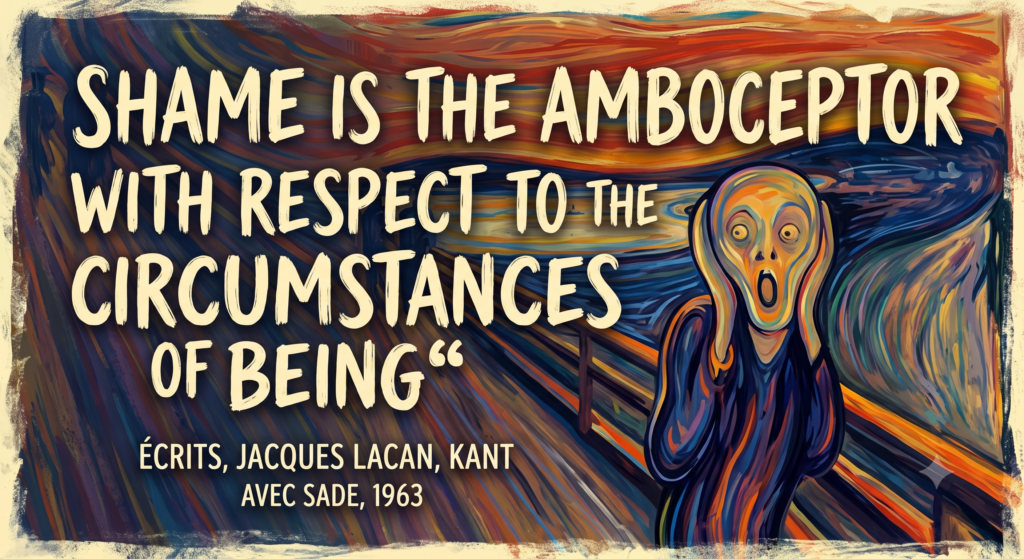
    The stakes are situated at the crossroads of the dimensions of statements and enunciation in Lacan’s enigmatic formulation from Kant with de Sade. Shame, or modesty, is an amboceptor with respect to the circumstances of being. It is a mistake, an error, reading Kant as a statement, as it is to cling to Lacan’s teaching like a leech. We have to understand the mistakes if we are to have any hope of understanding the stakes of the corrections. This is Christian Fierens’ reading, as I understand it, presented to The School of Psychotherapy (virtually) in September 2020. It is through the process of enunciating, Fierens elaborated, passing through the process of our experience of the ethics of the unconscious, a Sadian experience, that we can grasp, peut-être, an understanding of the stakes of our correction of the mistakes of statement.

    This indetermination calls for subjectivity, our singular agency of inventing a new universal law from the objet a, the small o of the voice, as Fierens insists. We are called to the act of speaking, to lean on our experience, without resources, without recourse to our clinical examples, or the good outcomes, if we are to bring to bear the modesty of the brute subject of pleasure. Psychoanalysis, rather than a practice of representation and interpretation of the phantasy must perpetually reflect on itself in a turning upside down in tune with the ethics of the unconscious.

    Am I speaking well (bien-dire) of shame? Here I trail off with the empty space of the three dots by which Lacan announced his prior seminar Ou Pire. Why am I lost for words and call on signifiers instead? Is it so shocking that I have been pushed thus far so as not to violate shame? Perhaps instead of looking to Jacques Alain Miller’s article on Guilt and Shame, Monique Selz on Shame and Modesty, and Susan Schwartz on The Barrier of Modesty, I push, as indeed Schwatz says, the advent of the real; pudeur unequivocally linked to sexuality. How dare I? Worstward Ho! My Sadian experience of analysis… an assault on modesty, my own assault, a somersault springing from my experience of “ab-sens”*.

    • Concepts touched upon in this paper are elaborated upon by Fierens in his seminal reading The Psychanalytic Discourse: A Second Reading Of Lacan’s Etourdit.
  • The Sound of Silence

    The Sound of Silence

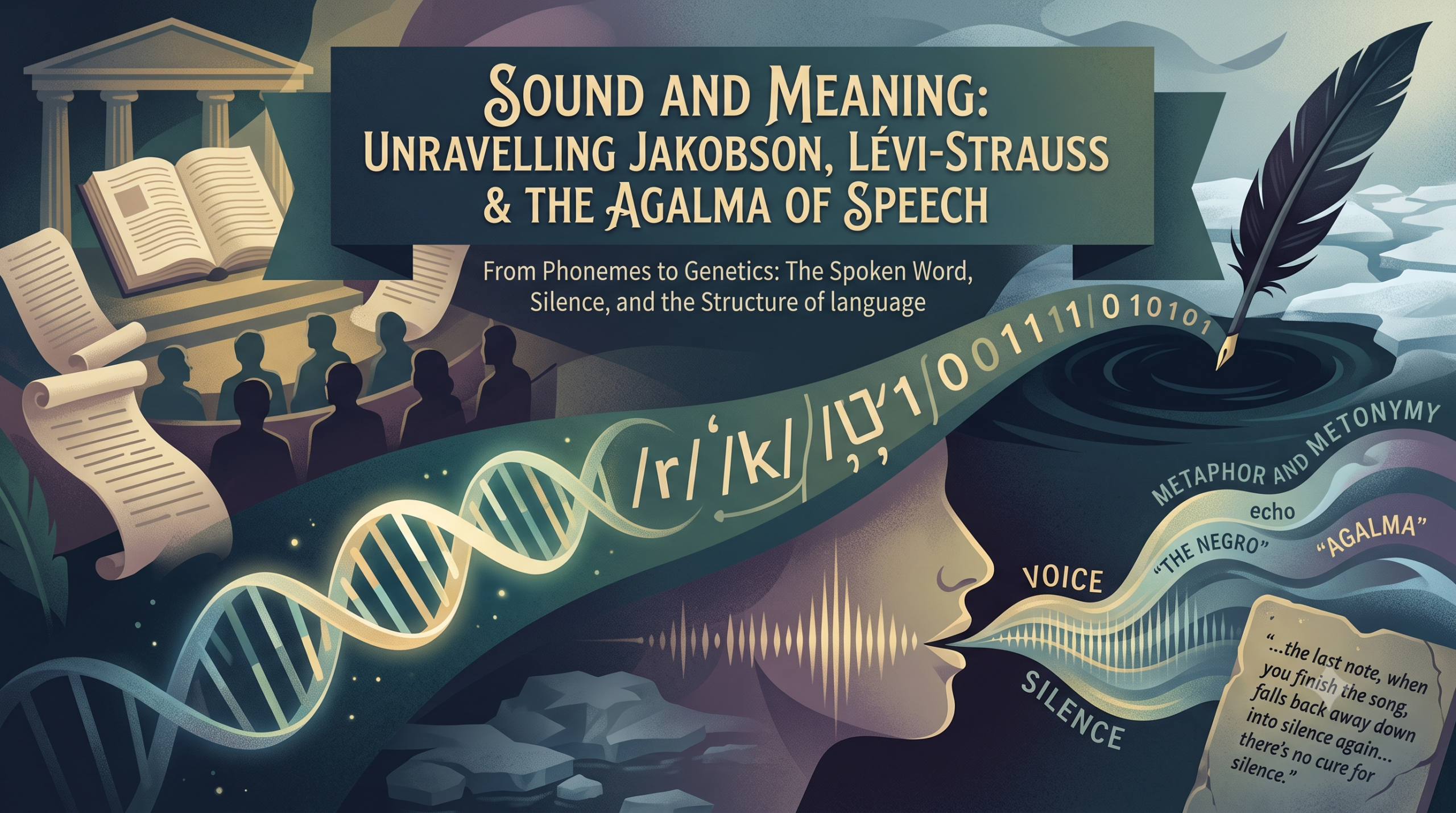
    Claude Lévi-Strauss, with whom Jakobson collaborated between 1942 and 1946 at the École Libre des Hautes Études in New York, and where Jakobson fled to from the World-War invasion of then Czechoslovakia, first to Scandinavia and then America, writes the preface to Jakobson’s six lectures on sound and meaning. His contribution corrects one aspect of Jakobson’s concepts that would have changed over time, but one Jakobson himself hazarded at the time of writing. Jakobson had asserted that language is the only system which is composed of elements which are signifiers and yet at the same time signify nothing. The biological revolution, Lévi-Strauss reveals, brought the discovery of the genetic code, and he credits Jakobson as one of the first to marvel at the similarity between the genetic information system and that of verbal information, the verbal codes of all human languages.

    Here we have hints of the agalma of the spoken word, relation to time, and the criss-cross of the axes of conjectural science and scientific certainty; space and time, linearity and depth, succession and simultaneity. In his 1955 paper Two aspects of language and two types of aphasic disturbances, where he explores selection and combination in the linguistic sign, together with metaphor and metonymy, Jakobson proposed that in any given language there exist coded word groups, the meaning of which cannot be derived by adding together the meanings of its lexical constituents, ergo, the whole is not equal to the sum of its parts. Jakobson insists that a sequence of phonemes is not a simple mechanical aggregation but a structure which must manifest certain additional indices.

    He returned to Saussure in the six lectures who stated that should we “record on film all the movements of the mouth and larynx in producing a chain of sounds…..we would not know where one sound began and where another ended”. He understood that to study the phonatory act, phonetic units, is to observe something extrinsic being unconsciously brought in to play.

    For Saussure, phonemes are oppositive, relative and negative entities. It is not the movements of vocal apparatus for production of each acoustic image but the oppositions put to work by language, the dichotomous classification of phonemes “exemplified by binary opposition: presence and absence of the voice”. If we are to look at the roles of the active (read tongue) and passive (read hard/soft palate of the mouth) in the points of articulation, we fail to recognise the opposition between the hushing sibilants and hissing sibilants, the silent ‘k’s and the voiced ‘g’s. Michael Harding puts it plain in his own inimitable style when he is interviewed in the Pat Collins directed film Silence:

    Whenever you sing a song, the first note comes out of silence, and the last note, when you finish the song, falls back away down into silence again. And they say that no matter how many tunes you play, no matter how many songs you sing, there’s no cure for silence.

    Jakobson confronts the “mystery of the idea embodied in phonic matter, the mystery of the word”. The word, he says, is a unity of two components, two sides, sound and meaning, a combination of signifier and signified. Already we are drawn to the psychoanalytic parallels of phonic matter, the stuff of the unconscious and the dialectical oppositions latent therein. Jakobson goes on to describe phonic elements as units bearing signifying value, quanta of language, but cautions that these elements are of no value in their own right.

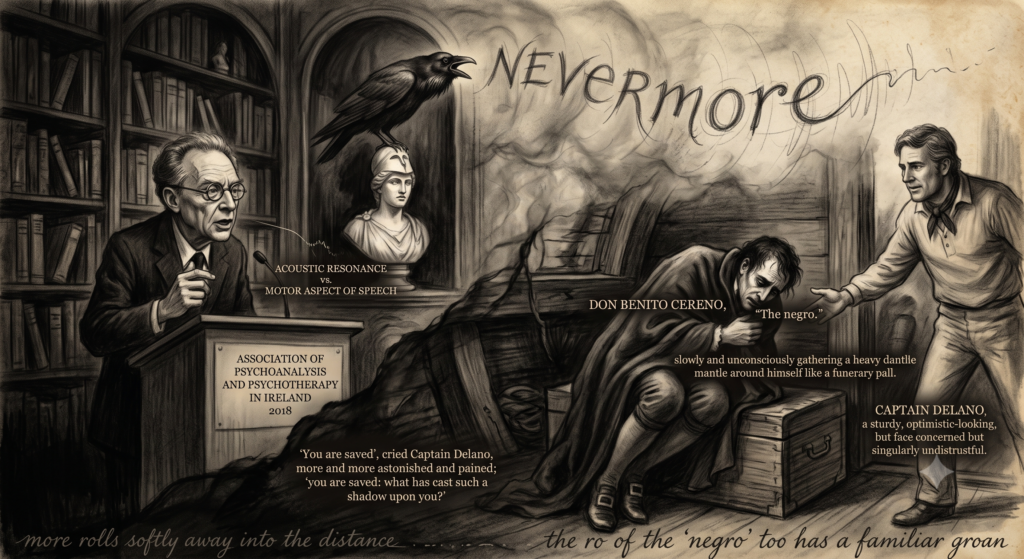
    Phonology investigates speech sounds in relation to the meanings with which they are invested, sounds as signifiers. The phoneme, an element at the service of meaning, is itself devoid of meaning. At the service of meaning! An investigation of the function of speech and language. Jakobson states that we speak in order to be heard and that it is in order to be understood that we seek to be heard. Roman Jakobson opens his first lecture with the example presented in Edgar Allen Poe’s poem The Raven; that of the sound of the closing word, “Nevermore”. He labours the final ‘r’, the most producible consonant, one that projects into the future or even eternity, while announcing negation of the future, negation for ever. His vignette calls to mind a sound that lingered long beyond being uttered at an event in 2018 held by the Association of Psychoanalysis and Psychotherapy in Ireland, where extracts of Herman Merville’s Benito Cereno were read aloud. It was from a passage between the two lead protagonists of the novella, the tortured captive Don Benito and the unquestioning Captain Delano, a man of “singularly undistrustful good-nature”. It reads as follows;

    ‘You are saved’, cried Captain Delano, more and more astonished and pained; ‘you are saved: what has cast such a shadow upon you?’

    (Don Benito replied) ‘The negro.’

    There was silence, while the moody man sat, slowly and unconsciously gathering his mantle about him, as if it were a pall.

    It is with the echo from the sound of these words that Jakobson differentiates the acoustic and the motor aspect of speech. The significance of a sound should not be over-determined by its motor qualities, the complexity of vibratory motions involved. Rather the acoustic resonance, something far more primal, minimal, infantile even. In the case of “nevermore”, more rolls softly away into the distance. The ro of the “negro” too has a familiar groan.

    In language there is neither signified without signifier, nor signifier without signified. The connection is not arbitrary, it is a necessary relation based on contiguity, that is what is outside and what is inside, external and internal. The intimacy of the connection between sounds and meaning of a word express a desire by the speaker to add an internal relation to the external relation, resemblance to contiguity, to complement the signified by a rudimentary image. We arrive at sound symbolism, the latent correspondence in the meaning of a word and towards pairs of words with two opposite meanings. Speaking of our interior speech, Jakobson says the words are not composed of emitted sounds but of their acountic and motor images, and as a rule, language is not for us an end in itself but only a means, the elements of language beneath our conscious deliberation. We might think of how a joke says what it has to say in too few words, something left out to allow more in, it goes without saying as the idiom goes, expressed in absentia, or Freud’s image of pack-ice in the dream work

    Whether it be successive or simultaneous combinations, aggregation does not say it all. This is why Jakobson moves away from Saussure’s linear character of the signifier in his principles of the linguistic sign. He credited Charles Bally’s determination that a sign can accumulate different signifieds simultaneously. Saussure it seems struggled with his own axes of simultaneity and succession, trying to overcome simultaneity by a virtual mnemonic series, therefore conceptually preserving linearity.

    Jakobson’s addition was to say that the signifier makes use of both axes, that the time factor itself becomes a value. Just as Lacan declared the objet petit a his private property (though there is no private property in language), the rest inherited from psychoanalytic thinkers before him, Jakobson’s contribution is to add a layer of addition, an extension to the meaning of the word.